

Beyond Fear: Inside Action Horror Games - Book Review and Q+A
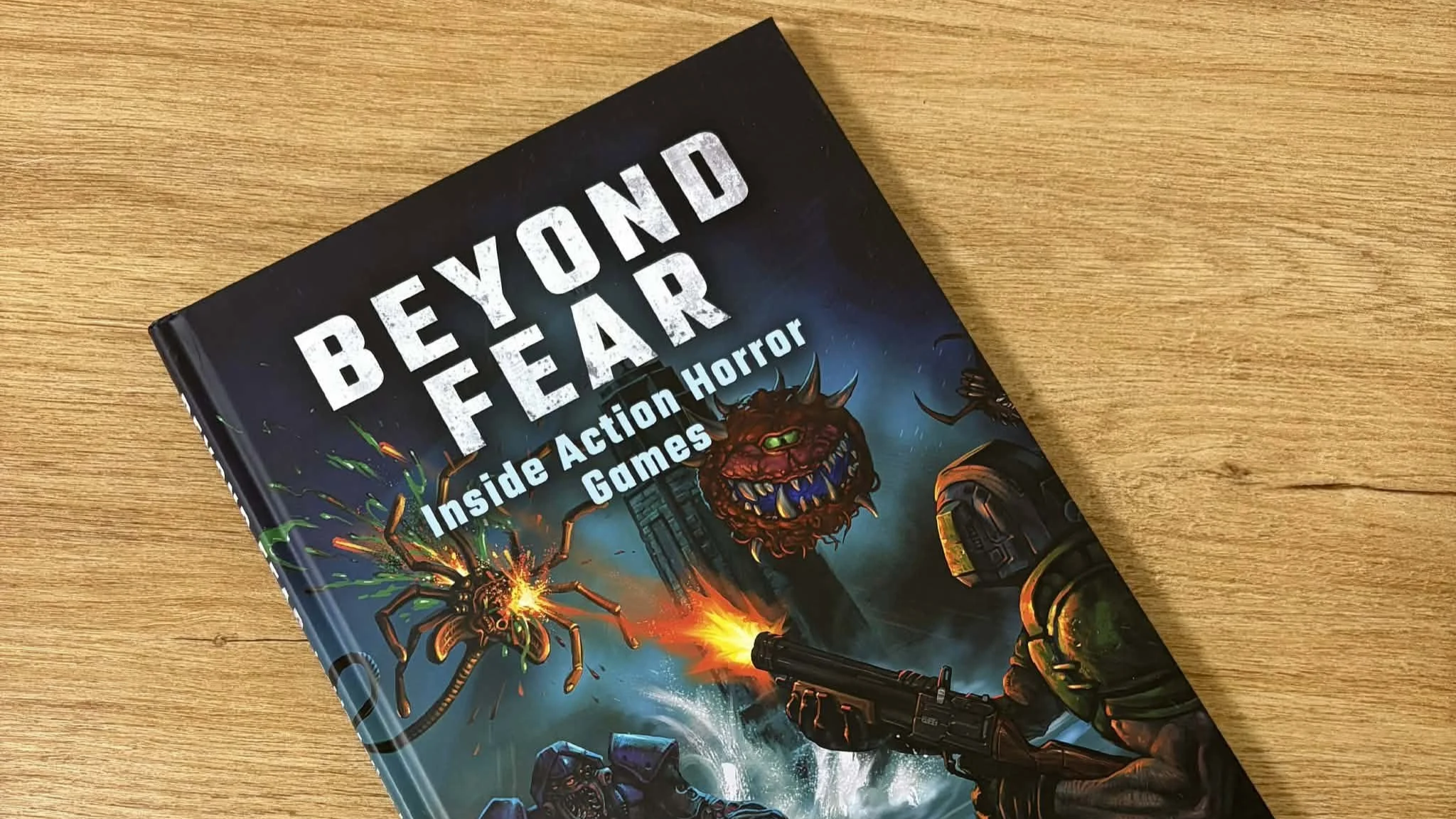
The stated goal of Beyond Fear is to explain how certain video games have blended action and horror to craft the best experiences they can in the most unvarnished ways possible and look beyond the popular mythologies surrounding the creation of these games by directly interviewing at least one and oftentimes more of those involved with each of the games covered within the book. Along these lines, John Romero’s foreword is an excellent introduction to what you’re getting, clearly written by someone who has both made and is a fan of action-horror games more generally.
Each chapter follows a particular format — covering a game’s development, paired with insight gathered from a designer or two, along with its legacy and the perspective of those designers. It is a lot of information that’s been publicly available for many years, but this is the first time it’s been collected into one tome rather than scattered across a mess of magazine and website interviews, so that’s a plus. To say nothing of the fact that, other than Doom and Half-Life, no one involved with most of these games has written books about their experiences.
As a result, the BioShock chapter proves especially illuminating. Ken Levine speaks on a wide range of subjects relating to the game and its development, many of them not necessarily related to the horror aspects, such as his reading of The Shining and how his perspective changed drastically between the time he originally read it at the age of 11 and the times he’s come back to it as an adult. It’s also quite clear that due to Levine’s game development background, he’s never really been one to be pigeonholed into the creation of ‘single-genre’ of games, despite the irony of rather dull and very much ‘FPS’ boss battles appearing at the ends of both Bioshock and Bioshock: Infinite, as mentioned at the beginning and end of this chapter.
When Levine speaks to the more horror-like aspects of Bioshock, it’s easy to see that much of this stems from him being a particularly detail-oriented designer, a quality that’s not quite as evident in the design of other video games. In BioShock, details and environments are melded together in such a way that it’s not just an abstract representation of what a particular location should be. Reading about Ken’s dedication to creating these sorts of environments reinforced the vague admiration I’ve had since the first time I came across a description of his design philosophy, probably 12 years ago now. The horror of societal collapse can perhaps be viewed as interwoven with this desire to invoke horror through striking details (or the decision to delay the action to allow the player to take in the environment/story for the first 10-15 minutes of the game).
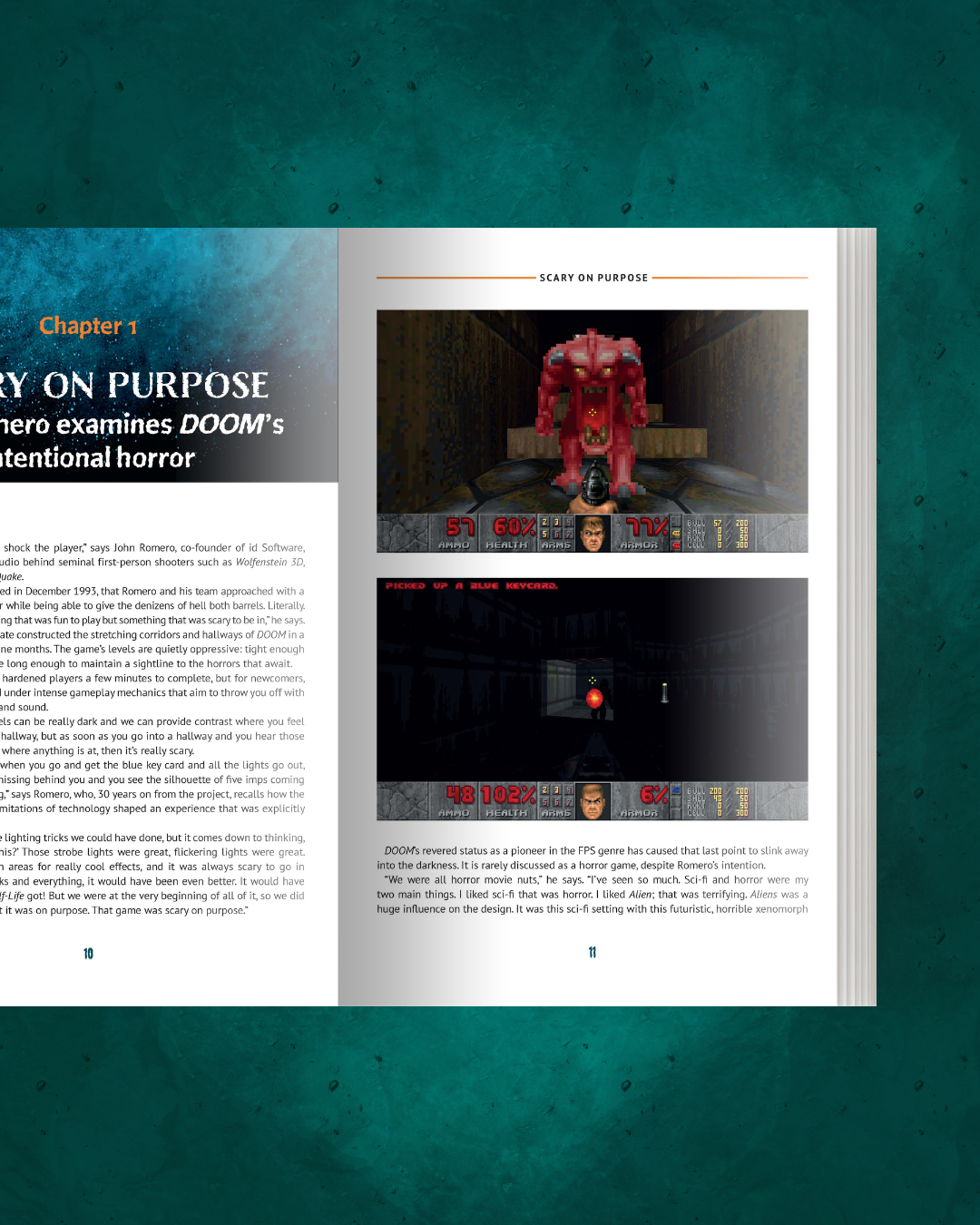
The other chapters are no less fascinating. John Romero and Marc Laidlaw may not necessarily reflect Ken Levine’s wide-ranging and eclectic influences. However, their game design philosophies shine through with enough clarity that they may be easier chapters to get through for the more casual reader. I especially liked reading in the Half-Life chapter how Laidlaw had always wanted to integrate his novelist background with more visual mediums before he ever thought about getting involved with video games. Side note: Half-Life 2’s inclusion in the Half-Life chapter was particularly interesting to me because outside of the stark and occasional B-Movie chilliness of Ravenholm, the horror angle’s not quite as obvious. Yet, as was also pointed out in this chapter, there’s a certain existential horror in returning to civilization and finding it’s been overtaken by a visible and authoritarian regime, underscored by the decision to set the game in a brutalist (Eastern European-esque) metropolis.
In the book, there initially seems to be an attempt at a vague timeline of action-horror, with mentions of games like Half-Life or BioShock that go on to get separate chapters. That mostly seems abandoned after the BioShock chapter, as the rather spicy Dante’s Inferno chapter doesn’t go into detail about the influence of other action-horror games. While a Returnal developer cites Alien Isolation as an influence, it’s clear from that chapter’s context that the game was just one inspiration among many.
In any case, these post-BioShock chapters are all quite interesting. Dante’s Inferno is actually a game I’d never heard of, since I wasn’t paying attention to current games when it was released in 2010. The included tale of a third-person action game attempting a fateful replication of the classic literary depiction of Hell, with level designs paired with routine hack-and-slash combat, was a little sad to read about. The descriptions of the various cringeworthy marketing campaigns around the game managed to alleviate those feelings, despite the rather negative authorial voice surrounding them.
I don’t have much to add about the Aliens: Colonial Marines chapter, as that saga is well documented. I once spoke with a former TimeGate Studios employee who confirmed the schizophrenic managerial conditions that were the primary reason the game turned out the way it did. It does make for a strong contrast with Alien: Isolation, which was a game of relatively limited scope that received no outside interference and was allowed to gestate into one of the most unique (to say nothing of terrifying) games of the past 14 years.
The inclusion of more modern horror serves as a satisfying bookend. The tale of former bullet hell developers Housemarque going on to create a sci-fi horror roguelike with the stamp of its previous titles still heavy in its DNA with Returnal was quite fun to read about, especially when reflecting on how they were able to transition to a story-focused experience rather than their original arcade-centered titles. The parallels between Returnal and Hades, another roguelike featuring heavy amounts of lore and upgradeable equipment that make the ultimate gameplay loop triumph considerably more likely, were hard to ignore.
The last chapter is all about the infamous Resident Evil Village’s Lady Dimitrescu. It’s notable for its decision to focus solely on one aspect of the game rather than the whole thing. She’s such a striking character that it’s surprising no one at any point thought that her importance to the story ought to be increased, as the pre-release fandom more than abundantly seemed to demonstrate in retrospect.
For the author’s first book, Beyond Fear was a very fun read overall. Keep in mind, though, that it’s really meant to be less a comprehensive history of action horror and more a way to tell the story of certain games, based around the words of people who worked on them directly. Akerman barely even expressed an authorial perspective, other than rightly criticizing the treatment of women in the gaming industry in the Dante’s Inferno chapter, as exhibited by the “Lust” marketing campaign dreamed up by unnamed EA suits, and allows the developers to speak for themselves and to their roles, creating some of the more fascinating horror titles of the last 30-odd years.
For more information about Beyond Fear: Inside Action Horror Games, check out the official listing or find the book at retailers such as Amazon.
Q&A with author Nick Akerman
What inspired you to write Beyond Fear?
Quite funnily, the inspiration for the book didn’t come from an action horror game. Hideo Kojima’s P.T. provided the spark for the idea that eventually developed into Beyond Fear.
I’ve always thought deeply about horror games, but my obsession with P.T. took this to another level. The game’s oddities and the things you can miss just really got under my skin in the best way possible. I started to think about the intention behind developer decisions, and why they include certain bits that many players won’t see (If you’ve played P.T. and can see Lisa hanging over the balcony in your mind’s eye right now, you know what I mean).
That fascination made me want to read all about horror games. I scoured bookshops for well-researched writing on the genre, and I couldn’t find anything that satisfied what I was looking for. Either the writing was too academic or too light. So I set out along the path of working on a project that I wanted to read.
I approached publisher Pen & Sword with a ‘History of Horror’ in mind - something that would be accessible, entertaining, but still offer depth. The pitch was accepted, but before long, the project organically evolved into something completely different. I started to secure interviews with industry icons such as John Romero, Ken Levine and Maggie Robertson. Their excitement and raw honesty helped carve an obvious through line on action horror and how that type of game functions. It was such an exciting transition that elevated the entire thing.
While P.T. was the catalyst, if we’re talking inspiration from a particular game, a keenness to document these personal stories in print also played a massive part in pushing me on. I have lost hundreds of articles to websites shutting down. The industry is crumbling, people are being driven out every single day, and great work is being thrown away at an unsustainable lick. It’s extremely important to me that I play a part in helping record these stories and this history in a physical way.
What was your favorite part of writing Beyond Fear?
Having the chance to interview so many big names energized me. The enthusiasm and the genuine willingness to give themselves to the project really make the finished book what it is.
Interviews are such dynamic situations that are full of vulnerability when you’re looking back on work someone has put out to the world. Most of these conversations took place years after each respective game was released, so there was no pressure on the interviewee to be super PR-focused. The honesty and self-reflection that allows, and the raw emotion in parts, are my favorite things about Beyond Fear.
Getting to the heart of the person behind the game was at the center of it all. It was such a rewarding experience.
What was the hardest part of writing Beyond Fear?
The uncertainty within the games industry was difficult to navigate at times. Plans I had for entire chapters, even deep into the book’s creation, had to be shelved long after interviews were set up and ideas were ready to work on.
I also think, as a first-time author, just getting through the process of planning, writing and delivering a book is difficult. I learned so much about things that hadn’t even entered my mind when I first started working on it.
Were there any games you considered covering but ultimately opted not to write any chapters about?
Oh, so many, especially considering how the original plan wasn’t to focus on action horror.
I actually have multiple interviews completed that didn’t quite fit into this book, but may appear in another project further down the line. One is with an industry legend who is considered a pioneer of the horror genre for their work in the late 1990s. I probably shouldn’t say too much more, so I’ll leave it there.
Order Fearzine
![FEARZINE #4 - (Physical) [PRE-ORDER]](https://images.squarespace-cdn.com/content/v1/666df3b70ff3a55ff077d05e/08f8e0d2-c95c-4661-b188-b7aa144f3679/Fearzine_issue4_Coverart_FINAL_V01.png)
Issue 4 has sold out from its first print run so we need your help to get more in stock. A physical print copy of Fearzine #4 to hold in your hands like the good old days. Featuring QR codes for every game and creator show that links you to additional information and where you can find the game.
Orders Needed: 93
I fully expected Hellraiser Revival from Saber Interactive to be the kind of horror game I don't vibe with. Very quickly, Saber showed me that they are coming, and they are coming hard.