

This interview is a companion piece to Ali's review, "Statement begins - Where to begin with The Magnus Archives" Make sure to check it out here.
I’ve just had the strangest experience with a book I borrowed from the library.
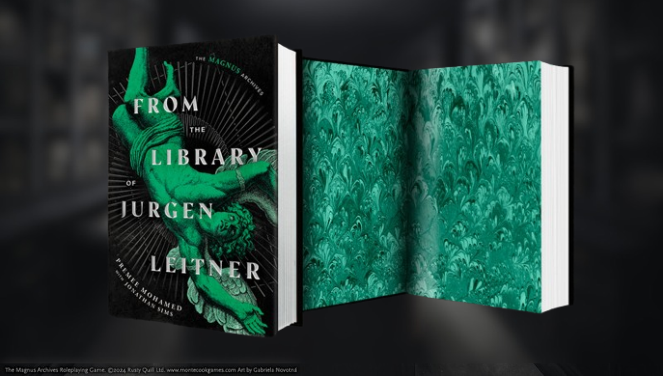
The moment I opened it, I found myself lost in a maze of books: endless floors of books that can bend bones or bind the dead to their pages. I escaped before I lost myself in any more tales, but be careful if you pick it up, for the angel on the front might just lead you to the same place. The cover reads “From the Library of Jurgen Leitner”...
From the Library of Jurgen Leitner is the brand-new book from the world of The Magnus Archives, the immensely popular horror fiction anthology podcast, which has just made its way into bookshops. I had the immense pleasure of chatting with writer and voice actor of The Magnus Archives, Jonathan Sims, and the producer of The Magnus Archives and Founder of Rusty Quill, Alexander J. Newall, after they hosted a panel at MCM Comic Con all about The Magnus Archives podcast and the book's release.
Written by Nebula-Award-winning author Preemie Mohamed and co-authored by Sims, the two have crafted a new tale that expands on one of the podcast's most infamous characters. Chatting with Sims and Newall, I learned that the novel does more than just expand on the twisted past of Jurgen Leitner; its fresh horror may just terrify us in a totally new way.
Spoiler alert: The following article won’t steal your eyes or make you DIG, DIG, DIG - but it does contain spoilers for The Magnus Archives podcast
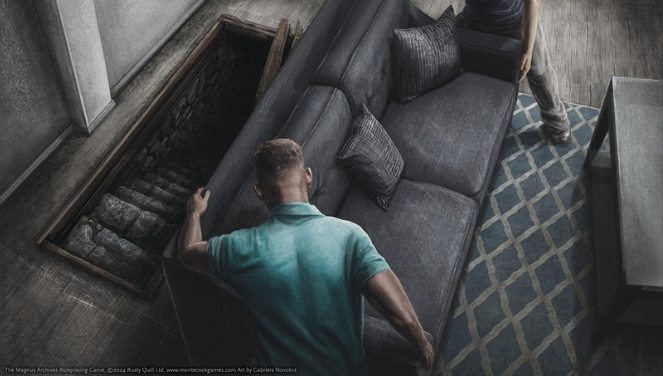
Unfinished brickwork and unfinished business.
Filling the library
It’s been a busy few weeks for Sims and Newall, which included signing over 2000 book plates and presenting a panel discussing the novel at MCM Comic Con. After their panel, I picked their brains on how Jurgen Leitner, an infamous character and occult tome collector from the podcast, became the focus of the first Magnus Archives book.
“We wanted a big name,” Sims begins. “We wanted one of the characters that both would draw fans in and provide a lot of good material for a fresh horror story. There are lots of very cool fan favorites, or really brilliant characters in Magnus, but a lot of them have their stories told.”
“Leitner was one of the characters that has this whole history that is his life, a long, very interesting, very weird life that we deal with in like a single podcast episode,” Sims continues, referencing episode 80 in which Jurgen Leitner, voiced by Paul Sims, tells the story of how he began his collection of occult books. While listeners know the books he collects hold unique powers (and grant their readers a terrible fate), the new novel delves much further into the history of Leitner and the Library.
“Within the 3000 words we had, if that, to talk about him in his episode, there's so much more. And not just about Leitner, there's really rich soil for other characters, for other horror stories, so he just felt like a really natural fit.”
“Part of it as well is when you're working on stuff like that, there's something called white spaces,” adds Newall. “The idea that A) you can't tell every story, and B) you shouldn't, that's a bad idea, right? Because then it's a bloated mess. Then it's finding the bits where you can.”
“I have always been of the opinion that there's not actually a Michael novel.” Newall continues. ”I think it would be a real struggle because so much of the character is dealt with that there isn't much; you'd be inventing instead of revealing.”
“The end of Leitner's story is told in the Podcast, but that leaves a lot of white space”, Sims agrees. “The second that you have a character who is coming in, who has lived a full life, and then their path has passed through this story and either moved on again or ended there, then there’s something to work with.” Newall adds.
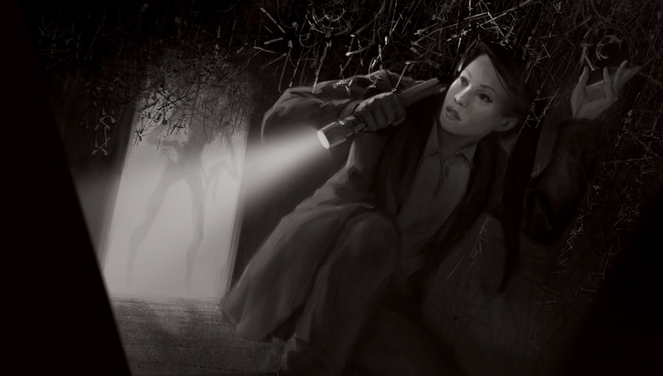
She can see a solution down here. Or maybe it’s something more.
Owning Books, Owning Solutions
When you know what white space you have to fill, it’s then a case of how to best fill it. Sims and Newall both seem to use a method of separating good confusion and bad confusion from the feedback they get, both from coworkers and fans, to figure out how they can tell fresh horror stories like the story of Leitner in the new novel.
“Good confusion is when it's perfectly fine”, Newall explains. “That's when it's 'I don't really understand what this character's doing ’, and you're there going, 'You will’, or 'I don't really understand why this character's done this ’, and it's 'Yes, because that's going to be revealed.’”
“Bad confusion is when it doesn't really make sense,” Newall continues. “Like, ‘this series of events, I feel like it's meant to make me feel sad? and mostly I'm just kind of waiting for the beat?’”
“A perfect example is if you do your big reveal episode where you reveal that ‘the car was alive’ and the fan response is ‘I wonder if the car's alive?’ You're like, ‘cool, I mucked it up, I got to fix that.’ That's the only real time, and even then, it tends less to be with story, and it tends to be more to do with tone and pacing.”
Sims agrees with Newall's methods, explaining how the same method of good confusion and bad confusion applies to game design. “There's a truism in game design when you're playtesting, which is that your test players are always right about what doesn't work, but are never right about the solution.”
“Often it will be, 'I felt like I wasn't getting enough rolls on a table; I should roll more,’ and you look, and you're like, 'I don't think the number of rolls is the problem; I think the rolls aren't feeling meaningful.’”
These core principles of writing seem to be followed closely in the new book, especially with how much world-building has already been done for the world of The Magnus Archives. Many of the loose ends of the twisted world of Magnus have been addressed by the podcast's end, but it’s the loose ends like Leitner that may just make for the best chilling new stories. Listening to how others react to and how others feel about your work may guide you to a solution, but as proven by Newall and Sims, the one who owns that solution is the writer.
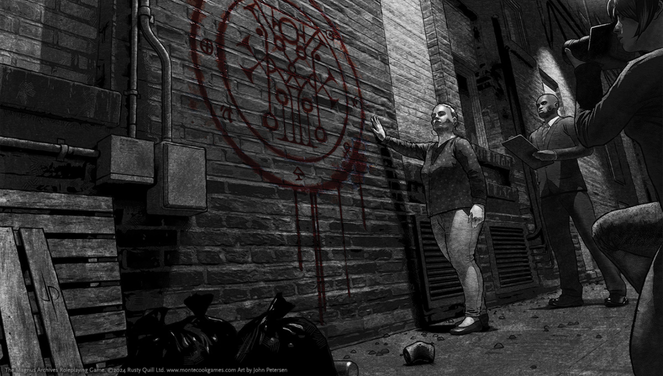
These investigations might lead to results
Impressive introductions
In the case of the book, one of those writers is Nebula Award-winning author Preemie Mohamed, a writer and scientist who previously penned novels including The Siege of Burning Grass and One Message Remains. After beginning to reach out to authors about the idea of a Magnus Archives novel, Preemie caught their attention from their first conversation.
“One of the things that jumped out about Preemie immediately was that literally the first time we spoke with Preemie, there was no explanation required,” Newall begins. “Preemie’s first question was essentially, 'Hi, so obviously I understand every single instance and every single nuance of this IP, but here's an incredibly specific element of law that I really, really need to know because it interacts with this thing over here.’ It was like, ‘You have skipped six months of research. You just know this already.’"
“That was one of the big green flags for Preemie. In the first meeting, Preemie was like, ‘Cool, here's this one thing I need to know,’ and understood essentially everything." And then the other one was like, ‘If I was going to do the story, I'd do full story pitch right here.’ It’s a pretty good introduction!”
“I think our styles mesh incredibly well,” agrees Sims, “and ultimately I really appreciated Preemie’s experience and sense of structure in the whole book, which I felt has given it a real shape that I absolutely love, and I just had a real good time writing for it.”
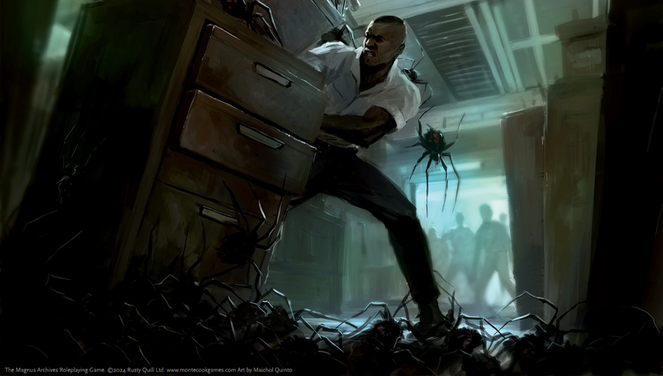
Tangled in a brand new web.
A Fresh Horror
That shape was something that is entirely different to the structure of the podcast, where almost every episode is a statement of a supernatural encounter read out by the archivist. The novel instead seems to focus on the story of the library rather than being an anthology, and it might have two perspectives that converge as it progresses.
“Novel writing is a new medium,” Sims explains. “It's a new discipline; the structural considerations are new.”
“With the podcast, we knew that we had this core conceit, and it was very important to us that that core conceit remained, whatever we did to it. However we hacked it up or twisted it or bent it out of shape or made it fresh, the core conceit was the story.”
“With novel writing, that's a lot more flexible. The long-form structure is a lot more mutable. There are all sorts of ways that you can structure a novel, and I'm really delighted with what we landed on for the Library of Jurgen Leitner. The dual perspective structure that ultimately maybe converges? Perhaps? We don't know!”
For those like me who have just started the book, Sims does give us a hint at what we can expect from its main characters. “Hugh Franklin, you are going to run into a lot of ‘oh my god, this guy!’ and from Sebastian Everett, you're going to run into a lot of 'oh my god, this guy!’ Frustration from Hugh, light disdain from Sebastian!”
Newall agrees and adds his own interpretation: “One of them gets a lot of stuff done, and you wish they wouldn’t. One of them really struggles to get anything done, and you kind of wish they would!”
“Hugh is very wet cat coded!” Newall exclaims as Sims laughs and adds, “I've rarely seen a drier cat than Sebastian!” A bit of a loser who tries too hard and a bit of a veteran who tries too little? My favorite kind of characters!
What powers does this Leitner hold? I've not yet read far enough to find out for myself, but it’s already chilled me to the bone. While it’s a Magnus story at its core, its new perspectives already have me seeing Leitner and the new characters it introduces in unique ways, and frightening me in new ones. Speaking to Newall and Sims not only has me excited to read more of the book and future Magnus stories, but has given me a new appreciation for how much work goes into crafting and adding to such an extensive world.
From the Library of Jurgen Leitner has bound itself firmly to my bookshelf and my nightly reading routine, scaring me more with each chapter until what I can only expect will be a terrifying payoff. With all the terrifying new ideas in this book, and the next novel, Work Your Fingers to the Bone, based upon the sequel podcast The Magnus Protocol, announced at the panel, the world of the Magnus Archives is delivering fresh horror for new and returning fans alike. I’m all too excited to read more, but if I’m not back by the time I’ve finished reading, then just know there’s a good chance I’m still lost within the library…
Screenshots were provided by Penguin Random House, Imprint: Del Rey, Gabriela Novotná, Jacopo Schiavo, John Petersen and Machiol Quinto.
Find more about From the Library of Jurgen Leitner by visiting the official website.
Have you visited the Magnus Archives yet? Share with us in the comments.
YOU MIGHT LIKE


I'm not one who favors this genre of atmospheric puzzle platformers, but the visuals and pretense of running from danger lured me in.